
Everything Mrs Doubtfire Taught Me About Parenting
On the 1993 classic, and inspiration for stepdads everywhere.

Child #1 told me the other day that Pocahontas was the best film ever. I wasn’t convinced by her reasoning, so I asked whether she’d seen The Godfather. Or Citizen Kane. A lot of people think that’s pretty good, I said. I then talked her through the plot of Shawshank Redemption, which she also revealed she hadn’t seen. But she was insistent—Pocahontas was the best. (I thought better of pointing out that she’d told me it was Tarzan the day before...)
There’s another contender for best film ever that we didn’t talk about, one that was a staple of festive schedules back when people used to stick the telly on and watch whichever movies ITV2 had bought the rights to.
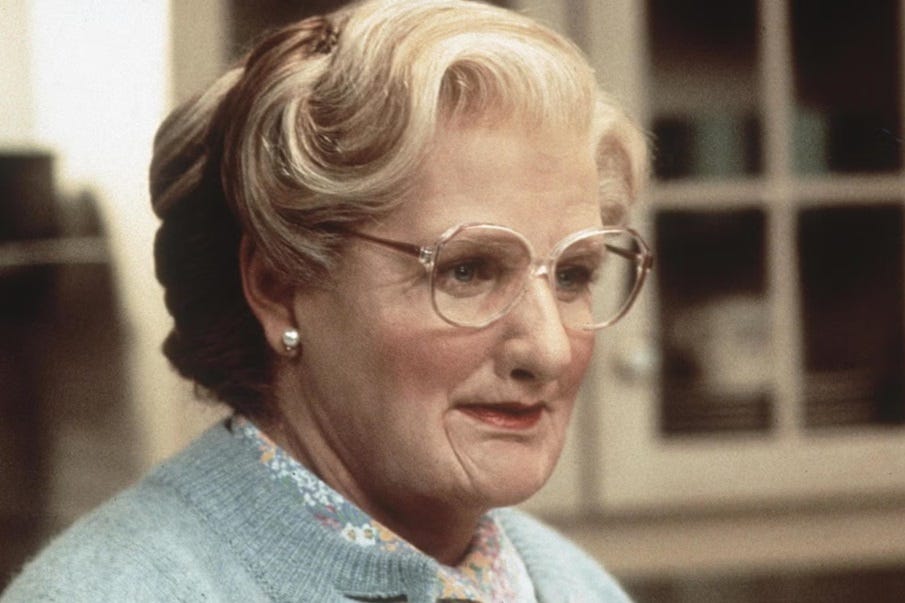
When I was a kid I loved Mrs Doubtfire. I had the VHS and watched it a lot. If you were alive in the 1990s and it somehow passed you by, then in brief: Robin Williams plays a fairly crap dad. He’s nice and funny and loves his children deeply, but he’s just too much of a big kid himself to successfully raise any. His high-flying, highly-strung wife Sally Field one day decides she’s leaving him. Robin (Daniel Hillard) can’t hold down a proper job and doesn’t have a home any more, so Sally (Miranda) takes the three kids with her. When Miranda advertises for domestic help, Daniel hits on the ingenious idea of posing as a venerable Scots housekeeper with the aid of some significant make-up and prosthetics, and going to work for his kids as the eponymous Mrs D.
It has perhaps not aged quite like a fine wine. Some of its content would I suspect make a sensitivity viewer’s eyes gush. But eight-year old Mark didn’t have much awareness of how trans discourse might develop over the course of his young adulthood. Problematic tropes didn’t exist back then, or if they did nobody had taught Little Marky about them. The film’s appeal to me was predicated on very basic foundations: “He does silly voices!”, “He’s dressed up as a lady!”, “Oh no, his face has fallen out the window!”.
The next time I watched it, late-ish in my twenties, it made for a very different viewing experience. The slapstick wasn’t as funny. Mrs D’s fake double-Ds had lost their transgressive power. Now I found it desperately affecting. It was only about four years after Robin Williams had taken his own life, so his every gesture and gurn, every sad smile and frown was glazed with sorrowful poignancy. It felt like watching a beloved uncle from beyond the grave on a home movie.
I was also by then in the throes of a divorce in what I have perhaps discourteously called my “practice marriage”. The reasons for our divorce were a lot more prosaic than Daniel and Miranda’s. We got married too quickly, too young and underdeveloped. We fancied the idea of having a whirlwind romance and a lavish party more than the quotidian reality of married life. We were mismatched in many ways that would become apparent too late. Furthermore, at that stage of my life I had only begun to form at best a casual acquaintanceship with the concept of monogamy. In all, a suboptimal set of conditions.
My ex-wife and I had no children, no property to split up, just a black cat with a lazy eye. It wasn’t a divorce so much as a break-up with admin. Yet I watched the film that Sunday afternoon, almost certainly suffering through some sort of hangover, and suddenly found the idea of a family breaking apart an achingly sad one.
Now I’m in my thirties, a husband (better-trained this time), and a father, there’s another part of the story that hits me. Newly separated, Miranda starts to date her old friend Stu (Pierce Brosnan, two years before his 007 debut). Stu is subtly villain-coded (suave, preppy, British-leaning accent, drives a German car). Daniel hates Stu and everything he stands for, hurling tropical fruit at his head, before indulging in some light attempted murder on a restaurant date.
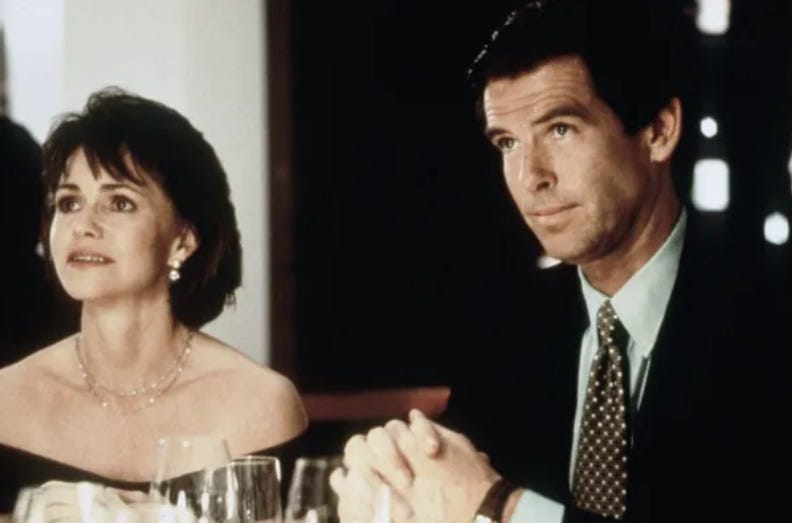
But let us consider, for a moment, Stu. A successful, attractive, eligible man. He reconnects with Miranda and courts her. It doesn’t faze him that she’s enduring a divorce and left with the burden of running a household and supporting her three kids. In fact he is interested and thoughtful and engaged with them. They soon go out and on holiday together. An early draft of the script had him as the antagonist, plotting to send the children to boarding school, but instead they made him an icon for dads (step- or not) everywhere. Stu, surely, is the hero of the piece.
Mrs Doubtfire has taught me a few lessons on this fatherhood journey. In brief:
Being funny is cute, but it’s one of a complex system of muscles you’ve got to flex to do the job well.
It’s up to you to keep your family together.
Check your childcare provider’s references thoroughly.
Don’t attempt to defraud your wife. It’s not good optics, and she will win.
One of the tests for a great work of art has to be whether you can enjoy it at different life stages and find new, compelling things about it. Mrs Doubtfire delivers on that for me. It’s almost as good as Pocahontas.
One of the things that has happened to me since becoming a mum is the realisation that his wife was not the problem here. I remember thinking she was so high strung and boring as a kid – the one in the way of the fun. But MY GOD, can you imagine getting home to the mess that party he threw would have caused, knowing you'd be the one to clean it. I'd have lost my damn mind.